 3 min
3 min ASMR Sand
Pick cutting and crushing videos of kinetic sand if you want crunchy tingles, and pouring or sifting videos if you want something for sleep. Use headphones. Skip it if sharp repeated crunching makes your jaw or shoulders tense.
Pick the type of sand
- Kinetic sand: the standard. It cuts cleanly, holds a block, then collapses into distinct pieces, which makes a dense crackle.
- Moon sand: softer and quieter, with a dull compression instead of a crack. If a "kinetic" video sounds muffled, it may be moon sand.
- Beach or play sand: no cutting, only pouring, sifting and raking. It sounds like a hiss, closer to rain or static than to a crunch.
- Wet beach sand: a lower, wetter squeeze. Try it if dry kinetic sand does nothing for you.
- Coloured craft sand: sharper and glassier. Some people love it, and sound-sensitive people may hate it.
Pick the technique
- Cutting: a thin blade or wire through a packed block. Usually the clearest crackle and the strongest response for most listeners.
- Crushing: palms or a flat tool. Broader and denser, and slow collapse adds a visual payoff.
- Pouring and sifting: a steady hiss with less personal attention. Better as a background or for sleep.
- Sculpting and molding: pick it if you enjoy watching whether a shape holds.
- Spiky rollers, cookie cutters and rakes: rollers make a popcorn-like sound, cutters are mostly visual and rakes are dry and repetitive.
Match it to your goal
- Anxiety in the moment: watch a cutting or crushing video. The rhythm is easy to anticipate and the slow collapse gives attention something predictable.
- Sleep: use pouring or sifting with no talking or music, screen face down, quiet. Cutting has abrupt sounds that can startle you.
- Focus: play it low so you are not aware of individual crackles.
Setup
Use headphones. Laptop and phone speakers smear the fine crackle, which is the main reason some people say sand does nothing for them. Keep the volume low enough that you focus slightly.
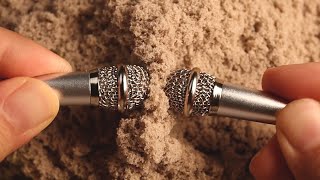
Videos recorded with a contact microphone, which picks up vibration through the material, can sound very close and intense. Search for contact microphone sand ASMR if standard recordings feel weak.
If it is not working
- Try a different surface or tool, such as sand on glass versus in a metal bowl.
- If sharp crunching tightens your jaw, that can be a misophonia-type reaction. Close the tab and use pouring or sifting instead.
- If it fades with daily use, switch to a different trigger for a week.
- If all your good triggers are soft, such as whispering and brushing, sand may feel pleasant but flat.
Making your own
For home sand videos, the water level controls the sound. A wetter mix fails all at once with a louder, sharper crunch but looks sloppy. A drier mix gives a lighter, more granular sound and cleaner edges. Many creators go slightly drier. Let the mix rest before recording.
What the research says
No study has tested sand ASMR specifically; the advice above is common practice, not tested results.
Best sand ASMR videos
3 min  0 min
0 min Very Satisfying and Relaxing Kinetic Sand ASMR, drop and squish
 5 min
5 min Satisfying Video l How to make Rainbow Photo Frame Cake FOR Kinetic Sand AND Pillar Cutting ASMR #05
 0 min
0 min Satisfying and Relaxing Kinetic Sand ASMR shorts
 0 min
0 min Very Satisfying and Relaxing, Kinetic Sand ASMR, Drop and squish
 1h 25m
 ASMR Most Satisfying Kinetic Sand Triggers for Sleep 마이크의 희생이 만들어낸 키네틱샌드 ASMR
 0 min
0 min ASMR: I Tried a Volcanic Sand Bath to Lose Weight! #shorts
 5 min
5 min ASMR:🎉Sand Cement slabs Shave /Carving & Crumble in lots of water with creamy paste play🤤
 0 min
0 min Very Satisfying and Relaxing, Kinetic Sand ASMR, Drop and squish
 16 min
 Hot Volcanic Sand Bath Massage ASMR
 1h 10m
 *1 HOUR* All of Very Satisfying ASMR Videos - Kinetic Sand Cutting ASMR Compilation
 10 min
 I Made VIRAL CRUNCHY STRESS BALL SQUISHIES! 😱😳 🫧*how to make diy squishy*
![ASMR Best Triggers for Good Sleep 😴 오늘 이 영상 보고 푹 잠들 건 '가바' [바이탈뷰티 X VITO ASMR]](https://i.ytimg.com/vi/HBNG1zIiYK8/mqdefault.jpg) 3h 20m
3h 20m ASMR Best Triggers for Good Sleep 😴 오늘 이 영상 보고 푹 잠들 건 '가바' [바이탈뷰티 X VITO ASMR]
 9 min
9 min ASMR IN PUBLIC (BÖDA SAND)
 2h 1m
2h 1m 4K ASMR | Ultra Relaxing and Satisfying Kinetic Sand 부드러우면서 자글자글한 키네틱샌드 소리
 11h 59m
 Creamy Brown Noise (12 Hours) BLACK SCREEN - Study, Sleep, Tinnitus Relief and Focus
 1h 3m
1h 3m ASMR Guaranteed Tingles 🤤 99.9% of You Will Sleep 소리가 너무 역대급이라 레전드 찍어버린 ASMR
 30 min
 ASMR | Volcanic Sand Massage For a Warm Sleep (Bathtub Massage)
 12 min
 ASMR ORANGE DESSERT, BASKETBALL JELLY POP IT, EDIBLE SAND BUCKET CAKE, ORANGE JELLO MUKBANG 먹방
 13 min
 ASMR YELLOW FOODS, EDIBLE SAND SHOVEL, WAX CANDY, FLOWER JELLY, LEGO DRINK, LEMON JELLO MUKBANG 먹방
 1h 13m
 ASMR 🤤 Проверяю 10 САМЫХ ЗАЛИПАТЕЛЬНЫХ ИГР в МИРЕ 🤪 АСМР
 18 min
 ASMR | Kinetic Sand & The Illusion of Time
 35 min
 BEST SAND ASMR VIDEO IN THE WORLD! +30 MIN Unusual Tingling & satisfying АСМР videos sounds KlunaTik
![[ASMR] Kinetic Sand & Encouraging Whispers](https://i.ytimg.com/vi/hHYzS0WNqGE/mqdefault.jpg) 20 min
20 min [ASMR] Kinetic Sand & Encouraging Whispers
 40 min
 Ear Cleaning & Extraction - ASMR - Sticky, Rubbing 0:40
 1h 14m
 4K ASMR | Very Satisfying Kinetic Sand Triggers for Sleep 흐물흐물하면서 쫀득한 키네틱샌드 4K ASMR
 51 min
 ASMR Tingly Sand Spheres (crunchy sand, gentle clacking, whispered rambles)
 2h 8m
2h 8m ASMR Very Relaxing Kinetic Sand Triggers 이것이 진정한 키네틱샌드 ASMR 입니다
 2h 30m
 Sand Blowing Over Dunes Sounds For Sleeping, Relaxing ~ Wind Storm Hill Dry Desert shore Ambience
 21 min
 ASMR Sculpting with Kinetic Sand
 32 min
 99.9999% of YOU will tingle to this ASMR!
![[ASMR] Sand Crushing & Eating .. (60 minutes of relaxation)](https://i.ytimg.com/vi/UFu3nhL5g1c/mqdefault.jpg) 1h 3m
1h 3m [ASMR] Sand Crushing & Eating .. (60 minutes of relaxation)
 1h 4m
1h 4m ♨️57°C Hot Sand Bath♨️ ASMR Real Spa Experience
 1h 13m
 ASMR With a Singer Microphone 🎤 노래방 마이크로도 팅글을 느낄 수 있을까?
 2h 13m
 ASMR My Foot Will Make You Sleep 100% 발로 만들어낸 ASMR
 8 min
8 min Fake Food #1 – I ATE Ice Cream From Sand (ASMR No Talking)
 11 min
 ASMR - 囁き 砂のおもちゃSO SAND DIYで遊ぶ音【サクサク】
 32 min
 UPLEVEL ONSEN ♨️ Volcanic Hot Sand Bath | ASMR
 2h 48m
 Christian ASMR ✝️ Sand & Scripture | THE MOST Peaceful Scriptures for Rest, Renewal & Deep Sleep
 3h 16m
 4K + 自然環境音 柔らかな水音を聴きながらリラックスする ストレス発散 リラックス 作業用水音
 16 min
 ASMR Kinetic Sand - Close Whispers and Sticky Fingers
 1h 0m
1h 0m Smooth Go To SLEEP 1 Hour Relaxing ASMR | Top Satisfying Video Kinetic Sand #compilation
![[ASMR] Shaving Cream Playing + Tracing](https://i.ytimg.com/vi/9XY5z7uBTxs/mqdefault.jpg) 23 min
23 min [ASMR] Shaving Cream Playing + Tracing
 39 min
 ASMR | New Setup, Who Dis? Sand, Lice, and Bugs Galore! - 2/12/22
 15 min
 ASMR: Kinetic sand- Whispered, visual triggers
Related triggers
Use sand ASMR for
Where to buy
| Item | Why it fits | ||
|---|---|---|---|
| Kinetic sand | Moldable sand for cutting and crushing sounds. | See on Amazon |
As an Amazon Associate, ASMR Registry earns from qualifying purchases. Links open Amazon search results. We have not tested these products.
Frequently asked questions
What is sand ASMR?
It is audio and video of sand being cut, crushed, poured, sifted or sculpted. Kinetic sand is the most common, because it makes many small crackles at once. Some people feel tingles from it and others just relax.
Does sand ASMR help with sleep?
It can for some people. Pouring and sifting videos with no talking or music and a steady sound suit sleep best. Cutting videos have abrupt sounds that can startle you, so save them for earlier in the evening.
What is the difference between kinetic sand and regular sand ASMR sounds?
Kinetic sand holds together and breaks into many small crackles when cut. Regular sand has no bonds to break, so it makes a steady hiss when poured. Choose kinetic for crunch and regular for a background hiss.
Why do sand sounds produce a more sustained tingle response than sharp trigger sounds?
Not proven. The dense, continuous crackle holds attention without needing active tracking, which is one reason some people find it steadier than a single sharp sound. Others find sharp repeated crunching unpleasant.
What makes some sand ASMR recordings more tingle-inducing than others?
Steady volume, no sudden noises, a slow pace and clean sound. Added music, too much talking or sound spikes hurt it. Close recording, including contact microphones, can sound more intense.
Does sand ASMR work as well through speakers as through headphones?
No. Headphones make a real difference because the sound moves between your ears and the fine grain detail comes through. Speakers flatten it into room sound.
- Use headphones for sand videos, because phone and laptop speakers smear the fine crackle into a flat background hiss.
- Use pouring or sifting videos with no talking or music for sleep, and keep cutting videos for earlier in the evening because their sudden sounds can startle you.
- Try different tool and surface combinations, such as sand on glass versus in a metal bowl, before deciding sand does not work for you.
- If sharp crunching tightens your body or makes you tense, stop and switch to a softer pouring video instead of pushing through.
- Search for contact microphone sand ASMR when ordinary recordings feel weak and you want a very close, intense texture.